Scholarship Exam vs Board Exam: What's the Difference?
If your child is preparing for board exams, you may wonder whether a scholarship exam is just "another test" piled on an already busy year. It isn't. The two serve very different purposes, and understanding the scholarship exam vs board exam difference helps you make a calm, informed decision about whether to sit both.
What each exam is actually for
A board exam is a qualifying exam. Its job is to certify that a student has understood the syllabus prescribed by their board (CBSE, ICSE, or a state board) and is ready to move to the next stage of school or college. It measures whether you have met a standard.
A merit scholarship exam has a different goal. It is designed to identify and support capable students by ranking them against one another. At ScholarsEdge, scholarships for students in Classes 6 to 12 are awarded purely on rank, based on exam performance and financial support is earned on merit, never left to chance. One exam tells you if you have passed; the other tells you where your ability stands among your peers.
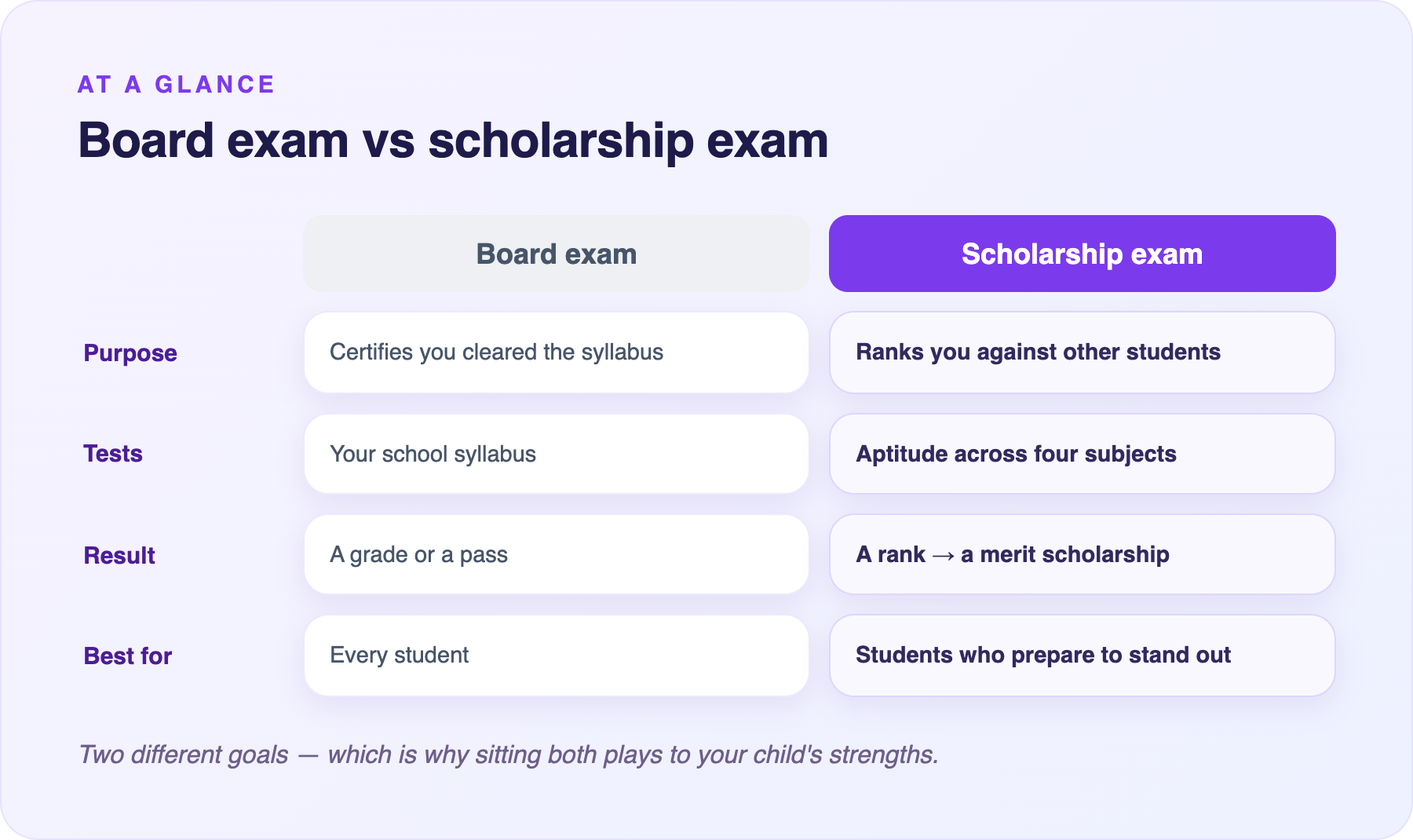 Board exam vs scholarship exam, at a glance.
What gets tested — and how it differs
Board exams follow your class syllabus closely, subject by subject, in the format your school has prepared you for. Scholarship exams are broader and more aptitude-focused. The ScholarsEdge exam, for example, assesses four areas:
- English — comprehension and language use
- Logical Reasoning — pattern-spotting and problem-solving
- Mathematics — applied thinking, not just formulae
- General Knowledge — awareness beyond the textbook
Notice that Logical Reasoning and General Knowledge rarely appear as standalone board papers. That is deliberate. A scholarship exam looks at how a student thinks, not only what they have memorised. This is also why a strong board student and a strong scholarship candidate often share the same foundation but stretch different muscles.
How scoring and outcomes work
Board exams are graded against a fixed standard — hit the marks, earn the grade. Everyone who reaches the bar can do well; there is no cap. Scholarship exams are rank-based: your performance is measured relative to other candidates, and awards go to the top performers on merit. At ScholarsEdge, awardees are drawn from a scholarship fund of over ₹5 Lakhs, awarded to students purely on their rank.
Think of it this way: the board exam opens the door to the next class. The scholarship exam recognises the effort that got you there — and helps fund the road ahead.
Why they complement each other
Far from competing, these two exams reinforce one another. School fees keep climbing, and many diligent families feel the squeeze each academic year — a pressure we explored in our post on the rising cost of school education in India. A merit scholarship directly eases that burden, and it is earned through the same discipline your child is already building for boards.
There is a confidence benefit too. Sitting a well-structured, AI-proctored online exam gives students low-stakes practice at performing under exam conditions — steadying nerves before the higher-pressure board season. The habits of timed practice, careful reading, and reviewing mistakes travel from one exam straight into the other.
How preparing for one helps the other
Here is the reassuring part for busy students: much of the preparation overlaps. Sharpening Mathematics and English for a scholarship exam strengthens exactly the subjects that carry weight in boards. Logical Reasoning trains the analytical thinking that makes board problem-solving faster. And the discipline of sitting mock tests — which ScholarsEdge provides so students can practise the format in advance — builds the exam temperament that pays off in every hall your child walks into.
In other words, time spent preparing for a merit scholarship is rarely time taken away from boards. More often, it is board preparation with an added return: recognition and financial support earned on rank.
So, should your child sit both?
For most families, yes. The board exam is non-negotiable — it certifies progress. The scholarship exam is an opportunity layered on top: a chance to have hard work recognised on merit and to earn support that lightens real financial pressure. Because the skills overlap, the extra load is smaller than it looks, and the practice can genuinely improve board readiness.
If you would like your child to be part of the next cohort, you can register your interest and receive details on dates, subjects, and mock tests.
The takeaway
A board exam asks, "Have you learned the syllabus?" A merit scholarship exam asks, "How does your ability rank — and can we support it?" They are different tools for different jobs, and together they give a capable student both certification and recognition. Prepare well for one, and you are already preparing for the other.