The Rising Cost of School Education in India - and the Pressure It Puts on Students

For most Indian families, a child's education is the single biggest long-term investment they make - and every year, it costs more. Admission fees, monthly tuition, books, uniforms, transport, and the near-universal expense of private coaching all add up to a number that climbs season after season.
Behind those rising figures is a quieter story that rarely makes the headlines: what the growing cost of education does to the students themselves.
Education in India is getting more expensive - fast
Ask any parent and you'll hear the same thing: school fees only ever go up - and faster than almost anything else in the household budget. Private-school fees, coaching classes, and entrance-exam preparation have turned a basic right into a major financial commitment.
For a single child in private school, parents can spend several lakhs across the school years - and for families with more than one child, that burden multiplies. Many parents stretch their savings, cut back elsewhere, or take loans to give their children "the best possible start."
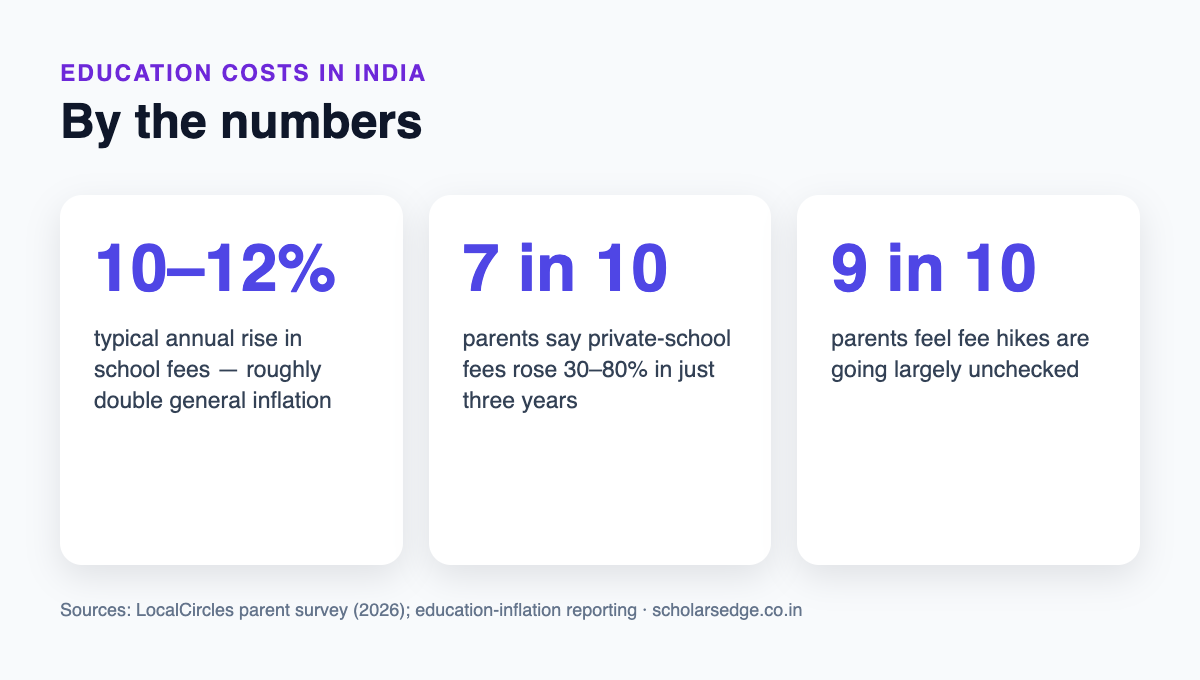
These aren't one-off spikes. School fees have been rising around 10–12% a year - well ahead of general inflation - and a 2026 LocalCircles survey of 47,000+ parents found nearly 7 in 10 reporting fee hikes of 30-80% in just three years. Most felt powerless to stop it.
The cost no one puts on the invoice: pressure on the child
When parents sacrifice to pay for education, children feel it. They know the fees are high. They know the coaching is expensive. And many carry an unspoken weight: "I have to score well to justify what my parents are spending."
That pressure is real, and it is growing. A fee receipt becomes an expectation; a good report card becomes a way to "repay" a parent's hard-earned money. Instead of learning out of curiosity or for growth, students can begin studying out of guilt and the fear of letting their family down.
The cost of education isn't only financial. For many students it's emotional - the quiet burden of feeling they must "earn back" every rupee their parents spend.
It is rarely talked about, yet it shapes how an entire generation experiences school: as a debt to be settled in marks, rather than an opportunity to be explored.
Why merit-based scholarships matter - for more than money
A merit-based scholarship does two things at once.
First, it eases the financial load. A scholarship directed toward fees, coaching, or learning resources reduces what a family pays out of pocket - and frees up money for everything else a household needs.
Second, and just as important, it reframes the pressure. When a student earns a scholarship on the strength of their own effort and rank, the story changes. The hard work is no longer about "justifying" a parent's spending; it's about being recognised for genuine merit. That shift - from guilt to achievement - can change how a child feels about studying altogether.
A scholarship turns "I must not waste their money" into "I earned this." That is a healthier, far more motivating reason to learn.
What a fair merit scholarship should look like
Not every scholarship programme is built the same way. A genuinely helpful one should be:
- Based purely on merit and rank - decided by performance in a fair exam, never by chance.
- Accessible - a real opportunity for many students to earn an award, not just a token few seats.
- Transparent - clear about how scholarships are awarded and how rank is calculated.
- Focused on education - directed at fees, coaching, and learning, so it relieves exactly the cost that keeps rising.
When more students can earn a scholarship on merit, the message to families changes: effort is recognised, and the cost of education becomes a little lighter for everyone willing to work for it.
The bottom line
The rising cost of school education in India is a financial challenge - but it is also an emotional one for the students at the centre of it. Merit-based scholarships can help on both fronts: lowering the bill for parents, and giving students a reason to study rooted in their own achievement rather than the fear of falling short.
Education should open doors, not weigh children down. A fair, merit-based scholarship is one practical way to keep it that way.