How to Prepare for a Scholarship Exam: A Class 9–10 Guide

A scholarship exam is not a test of luck; it is a test of preparation. For a Class 9 or 10 student, the good news is that a strong rank is earned through steady, focused effort, and with the right plan you can build that effort into your week without burning out.
ScholarsEdge is a merit-based scholarship exam for students in Classes 6 to 12. Scholarships are awarded purely on your rank, so every mark you earn through practice moves you closer to a place among the recipients. This guide walks you through exactly how to prepare, from understanding the subjects to a simple four-week outline.
Understand the Four Subjects
The exam covers four areas, and each tests a slightly different skill. Knowing what each one tests helps you divide your study time sensibly rather than pouring all your energy into a single favourite subject.
- English: reading comprehension, grammar, vocabulary and sentence sense. Reading a few pages daily builds this faster than memorising word lists.
- Logical Reasoning: patterns, sequences, analogies and puzzles. This is a skill you sharpen through regular practice, not something you cram the night before.
- Mathematics: concepts from your Class 9–10 syllabus, applied through problem-solving. Focus on understanding methods, not just answers.
- General Knowledge: current affairs, science, history and everyday awareness. A short daily habit of reading the news covers a lot of ground here.
Because the exam is AI-proctored and taken online, spend a little time getting comfortable with a screen-based, timed format before the actual day.
Build a Weekly Study Routine
Consistency beats intensity. A student who studies focused, forty-minute blocks five days a week will usually out-prepare one who does a single frantic weekend marathon. Aim for a realistic schedule that sits alongside your school and board-exam work rather than fighting it.
A balanced week might look like this:
- Assign each of the four subjects at least two short slots per week.
- Give extra time to your weakest subject; that is where your rank has the most room to rise.
- Keep one slot for revising notes from earlier in the week.
- Protect one day for rest so your mind stays fresh.
Write your routine on paper and stick it where you study. Seeing the plan makes it far easier to follow.
Practise with Mock Tests
Mock tests are the single most useful tool in your preparation. ScholarsEdge offers mock tests so you can practise the real format, and each attempt teaches you three things: what you know well, where you slip, and how the timing feels under pressure.
After every mock test, spend more time reviewing than you spent taking it. Note the questions you got wrong and, more importantly, why you got them wrong. Was it a concept gap, a careless error, or simply running out of time? Fixing the reason is what lifts your score on the next attempt.
Treat every mock test as feedback, not a verdict. A low practice score today is simply a map showing you exactly what to work on next.
Manage Your Time in a Timed Exam
In a timed, ranked exam, time management can be the difference between a good score and a great one. Many capable students lose marks not because they lack knowledge, but because they spend too long on one tough question and never reach easier ones later.
- Do a quick first pass, answering every question you find easy.
- Mark the hard ones and return to them once the easy marks are secured.
- Keep an eye on the clock, but do not let it panic you.
- Leave a couple of minutes at the end to review flagged answers.
Practising this rhythm during mock tests means it will feel natural on exam day.
Common Mistakes to Avoid
A few avoidable habits hold students back every year. Steer clear of these and you are already ahead of many peers:
- Studying only your strong subject. Your rank depends on your total, so balance matters.
- Skipping mock tests. Reading notes feels productive, but only practice builds exam stamina.
- Cramming the night before. Sleep helps your brain recall what you have learned.
- Ignoring mistakes. An error you never review is one you will likely repeat.
If you would like to understand how rank and merit actually decide the awards, read our explainer on how merit scholarship exams work.
A Simple 4-Week Outline
Here is a starting framework you can adapt to your own pace:
- Week 1 — Foundations: revise core concepts in all four subjects and take one diagnostic mock test to find your weak spots.
- Week 2 — Targeted work: focus on your two weakest subjects while keeping the others ticking over.
- Week 3 — Full practice: take mock tests under exam conditions and review each one carefully.
- Week 4 — Polish and rest: revise your notes, sharpen timing, and slow down in the final days so you arrive calm and confident.
With more than ₹5 Lakhs in total scholarship funds awarded purely on merit rank, a place is genuinely within reach for a well-prepared student. If you are ready to begin, you can register your interest and start practising with mock tests.
Your Takeaway
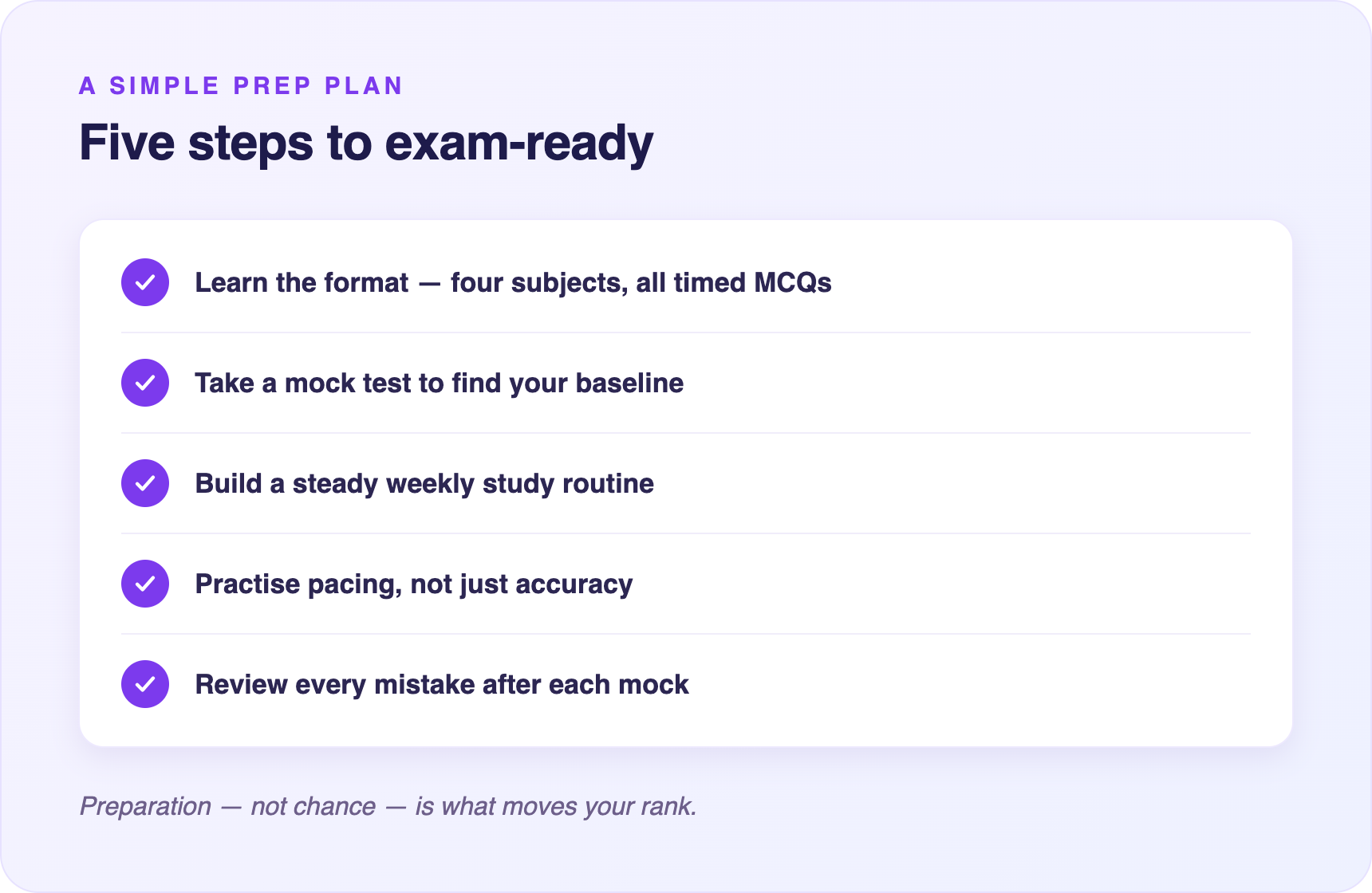
Preparing for a scholarship exam is a steady climb, not a leap. Understand the four subjects, build a weekly routine, practise with mock tests, manage your exam time, and learn from your mistakes. Do this consistently, and the rank you earn will reflect the effort you put in, one focused study session at a time.